
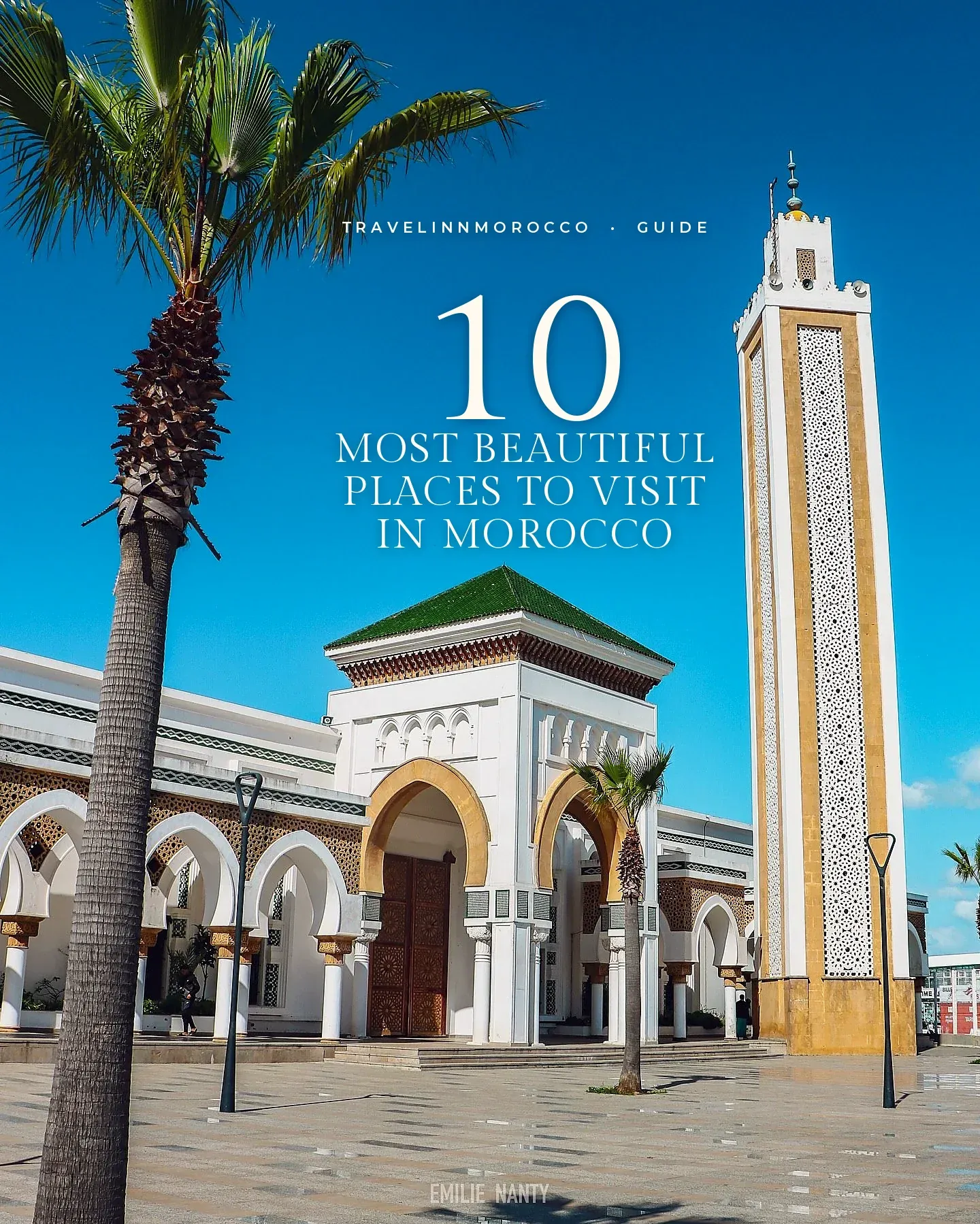
On a first trip, put these places first: Marrakech for its medina and Jemaa el-Fna square, Fes for the largest medieval medina in the country, the Merzouga desert to sleep among the Erg Chebbi dunes, Aït Ben Haddou, a UNESCO-listed mud-brick ksar, and Chefchaouen, the blue city of the Rif. With more time, add the Todra Gorge and Dades Valley, the High Atlas, Essaouira, Rabat and Volubilis. To see them all without rushing, you need about 10–14 days.
| First trip | Marrakech, Fes, Merzouga, Aït Ben Haddou, Chefchaouen |
|---|---|
| To see all 10 | about 10–14 days |
| Best time | March–May and September–November |
| Desert | October to April |
| Marrakech – Merzouga | about 550 km, 9–10 hours |
Morocco puts imperial cities, the Sahara Desert, the Atlas Mountains and the Atlantic coast into a single trip. This guide covers what makes each place special, how many days to spend there, the best time to visit, and how to combine them into a realistic route.
Contents
- Marrakech
- Chefchaouen
- Merzouga Desert (Erg Chebbi)
- Fes
- Aït Ben Haddou
- Essaouira
- Atlas Mountains
- Todra Gorge and Dades Valley
- Rabat
- Volubilis
- Comparison table
- Sample 7, 10 and 14-day itineraries
- Best time to visit Morocco
- Travel tip: one route that covers most of these places
- FAQ
1. Marrakech, the Red City

Marrakech is Morocco’s most visited city and the best starting point for exploring the south of the country. The Almoravids founded it in the 11th century, and its medina has been a UNESCO World Heritage Site since 1985. It’s called the “Red City” because of the ochre colour of its walls and buildings.
What to see in Marrakech
- Jemaa el-Fna square: storytellers, musicians and food stalls that come alive at dusk. UNESCO recognises it as Intangible Cultural Heritage.
- Koutoubia Mosque: its minaret, about 77 metres tall, is the city’s main landmark.
- Bahia Palace and the Saadian Tombs: fine examples of Moroccan craftsmanship in tilework, carved plaster and cedar wood.
- Ben Youssef Madrasa: a former Quranic school with one of the most beautiful courtyards in the country.
- Jardin Majorelle: the cobalt-blue garden restored by Yves Saint Laurent.
- The souks: each trade has its own area, from leatherworkers to dyers and blacksmiths.
How long: 2–3 days.
Best for: first-time visitors, couples, culture and shopping.
How to combine it: it’s the base for trips to the High Atlas (1–1.5 h), Essaouira (about 3 h) and the desert route via Aït Ben Haddou.
Local insight: the square changes completely through the day. In the morning it’s quiet and full of orange-juice stalls. At sunset it turns into a huge open-air dining room. For the view from above, head to one of the rooftop terraces around it.
2. Chefchaouen, the Blue City

Chefchaouen is a mountain town in the Rif, in northern Morocco, founded in 1471. It’s famous for its streets and houses painted in shades of blue. It’s one of the most photogenic places in the country and also one of the calmest.
What to see in Chefchaouen
- The blue medina and Outa el-Hammam square, with its red-walled kasbah.
- Ras el Maa, the spring where locals still wash clothes by hand.
- The Spanish Mosque viewpoint, a 20–30 minute walk away and best at sunset.
- Hiking trails in Talassemtane National Park.
How long: at least 1 night. With 2 nights you have time to walk in the surrounding hills.
Best for: photography, couples, travellers looking for calm.
How to combine it: about 3.5–4 h by road from Fes, and easy to pair with Rabat or Tangier.
Local insight: walk the medina early in the morning. The streets are empty and the soft light makes the blues look their best in photos.
3. Merzouga Desert and the Erg Chebbi Dunes

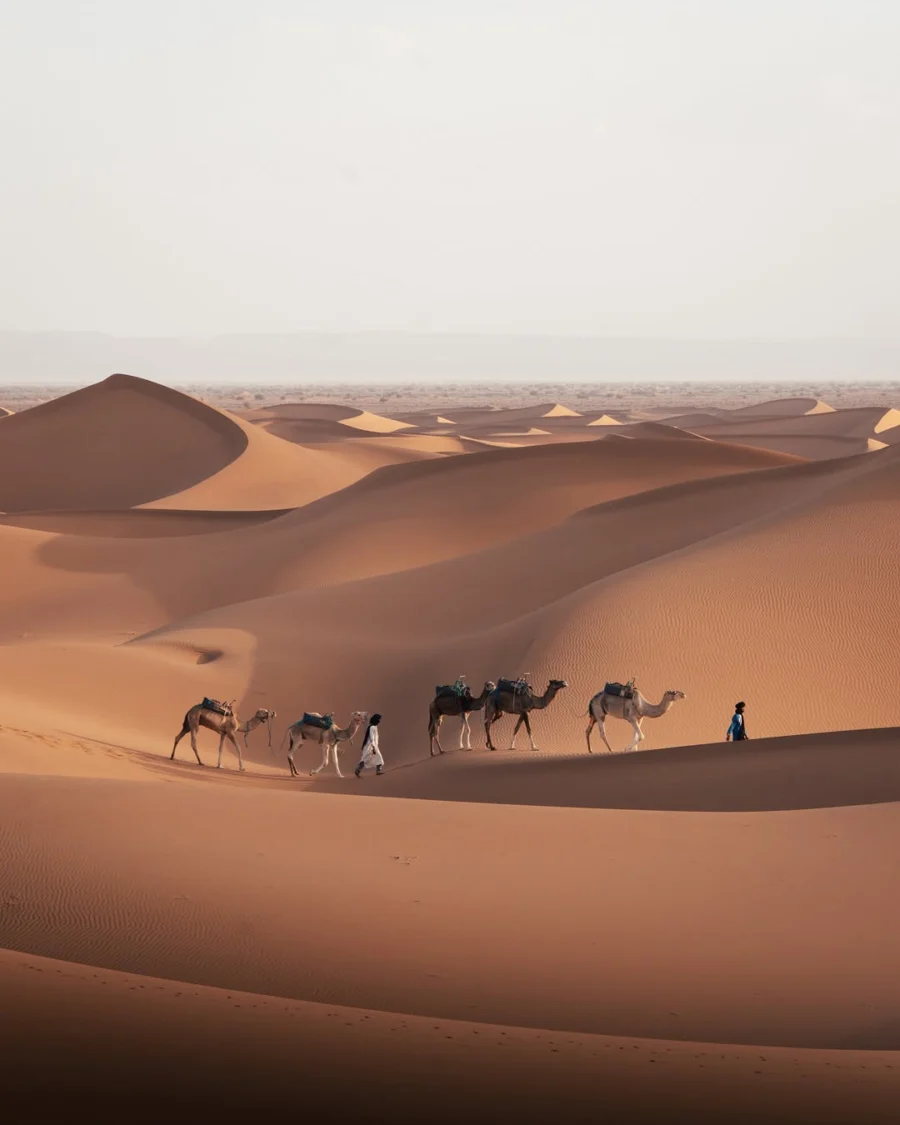
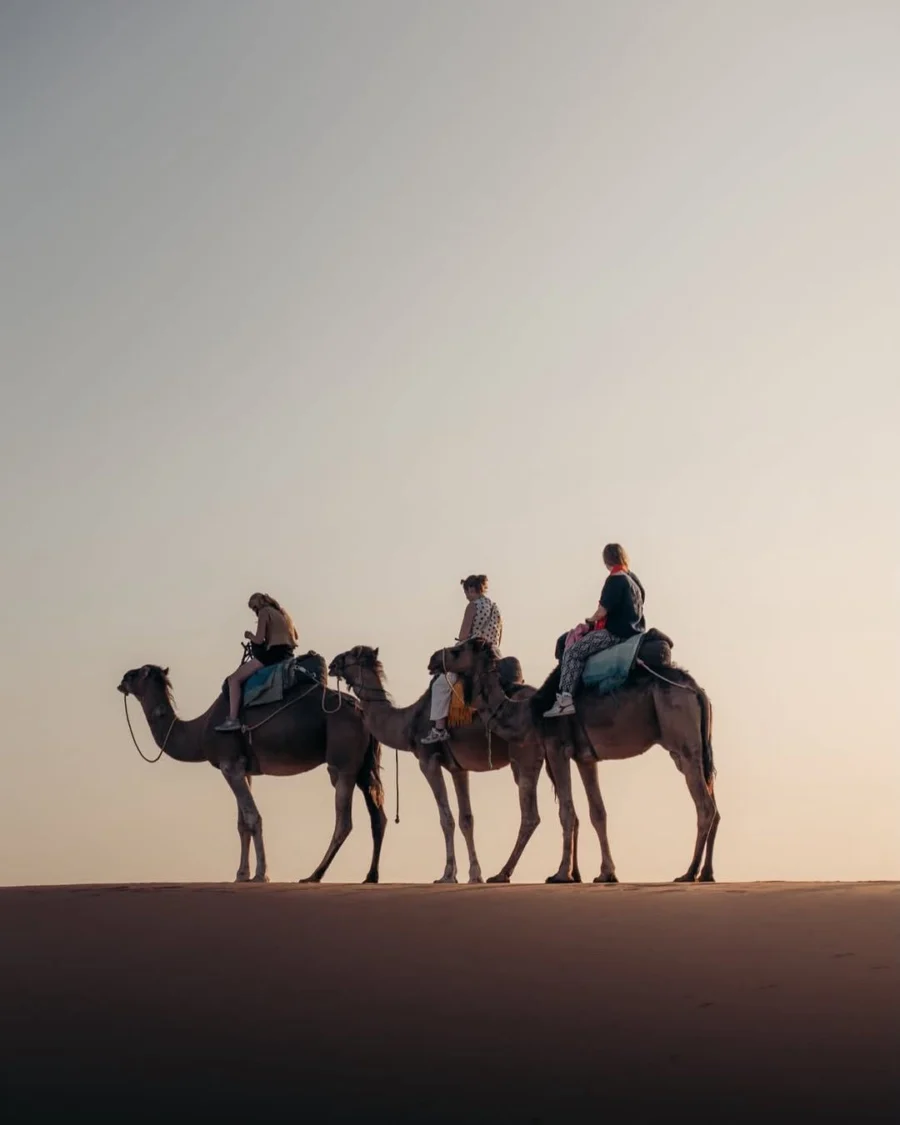
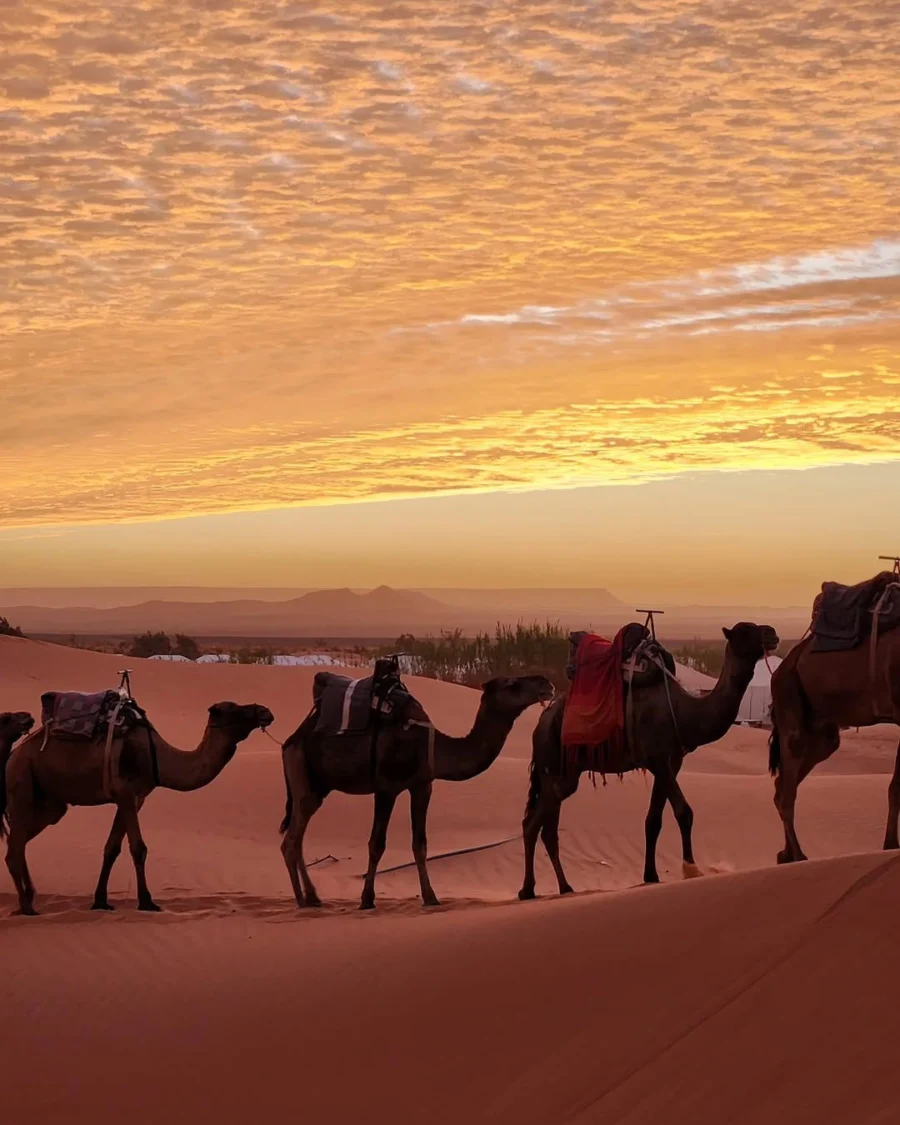
Merzouga is a small village in southeastern Morocco, next to Erg Chebbi, a sea of dunes that rise above 150 metres in places. It’s the most popular place to experience the Sahara in Morocco: a camel ride at sunset, a night in a desert camp and sunrise over the sand.
Things to do in Merzouga
- Ride a camel to your camp at sunset.
- Sleep in a Berber tent or a luxury desert camp under the stars.
- Climb a high dune to watch the sunrise.
- Go quad biking or take a buggy across the dunes.
- Visit Khamlia, a village with a Gnawa music tradition and live performances.
How long: at least 1 night; 2 if you want to enjoy it without rushing.
Best time: October to April. In summer daytime temperatures easily pass 40 °C, and in winter nights can drop close to 0 °C.
Best for: couples, families, adventure, photography.
How to combine it: Merzouga is about 550 km from Marrakech (9–10 h by road) and about 470 km from Fes (7–8 h). The easiest way to get there is a multi-day route with stops at Aït Ben Haddou, the Dades and the Todra.
Merzouga or Zagora? Zagora is closer to Marrakech, but its dunes are small. If you want the tall dunes everyone pictures when they think of the Sahara, go to Merzouga.
4. Fes, the Medieval Medina

Fes is the oldest of Morocco’s imperial cities and its great spiritual and cultural capital. Its medina, Fes el-Bali, has been a UNESCO World Heritage Site since 1981. It’s one of the largest car-free urban areas in the world, with thousands of narrow lanes.
What to see in Fes
- Al Qarawiyyin University: founded in 859 by Fatima al-Fihri, it’s considered one of the oldest educational institutions still running anywhere in the world.
- Chouara Tannery: hides are still dyed in colourful pits, just as they were centuries ago.
- Bou Inania and Al-Attarine madrasas: masterpieces of Marinid architecture.
- Bab Bou Jeloud: the “Blue Gate”, the main entrance to the medina.
- Artisan workshops: ceramics, brass and weaving.
How long: 2 days.
Best for: history, architecture, crafts.
How to combine it: it connects with Chefchaouen, Volubilis (about 75 min), Rabat (about 2.5–3 h by train) and Merzouga through the Middle Atlas.
Local insight: explore the medina with a local guide, at least on your first day. It’s easy to get lost, and a guide will explain what you’re seeing in each neighbourhood.
5. Aït Ben Haddou

Aït Ben Haddou is a ksar, a fortified village built of earth and mud brick. It stands by the Ounila River, about 30 km from Ouarzazate, on the old caravan route between the Sahara and Marrakech. It has been a UNESCO World Heritage Site since 1987 and has appeared in films and series such as Lawrence of Arabia, Gladiator and Game of Thrones.
Things to do in Aït Ben Haddou
- Cross the river and climb to the fortified granary (agadir) at the top, with views over the valley.
- Wander its mud-brick lanes and the houses that are still lived in.
- Visit the film studios in Ouarzazate, 30 minutes away.
How long: 2–3 hours, or 1 night if you want to see it at sunset.
Best for: film lovers, photography, architecture.
How to combine it: it’s the first big stop on the Marrakech–desert route, after crossing the Tizi n’Tichka pass (2,260 m).
Local insight: in the late afternoon the mud walls turn deep red. That’s the best time to photograph the ksar from the other side of the river.
6. Essaouira, the Pearl of the Atlantic
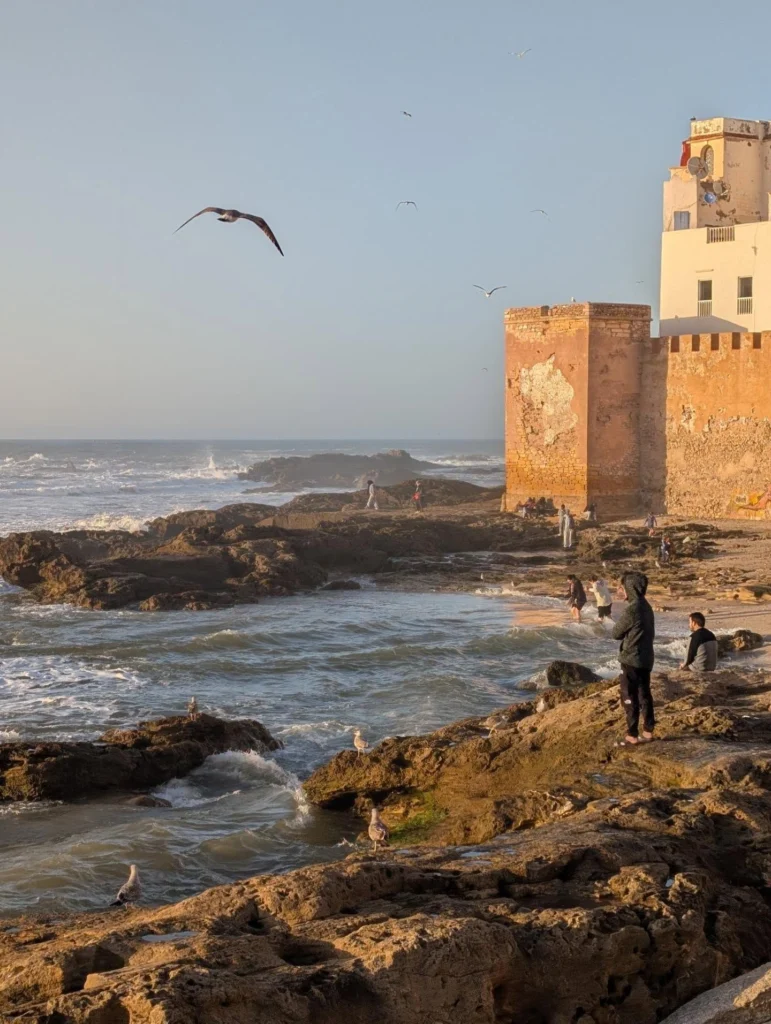
Essaouira, the former Mogador, is a coastal town with a fortified medina laid out in the 18th century. It has been a UNESCO World Heritage Site since 2001. It’s relaxed, windy and artistic, and the perfect contrast to the bustle of Marrakech.
What to see in Essaouira
- The Skala de la Kasbah, ramparts lined with cannons facing the ocean.
- The fishing port with its blue boats, where you can eat fish fresh from the auction.
- The medina, with art galleries and thuya-wood workshops.
- Its long beach, great for kitesurfing and windsurfing thanks to the trade winds.
How long: 1–2 days.
Best for: couples, families, travellers who want to unwind at the end of the trip.
How to combine it: about 3 h from Marrakech. It’s a good ending for any itinerary.
Local insight: every June the town hosts the Gnaoua Festival, one of Africa’s best-known music festivals. If you travel then, book your accommodation well in advance.
7. Atlas Mountains
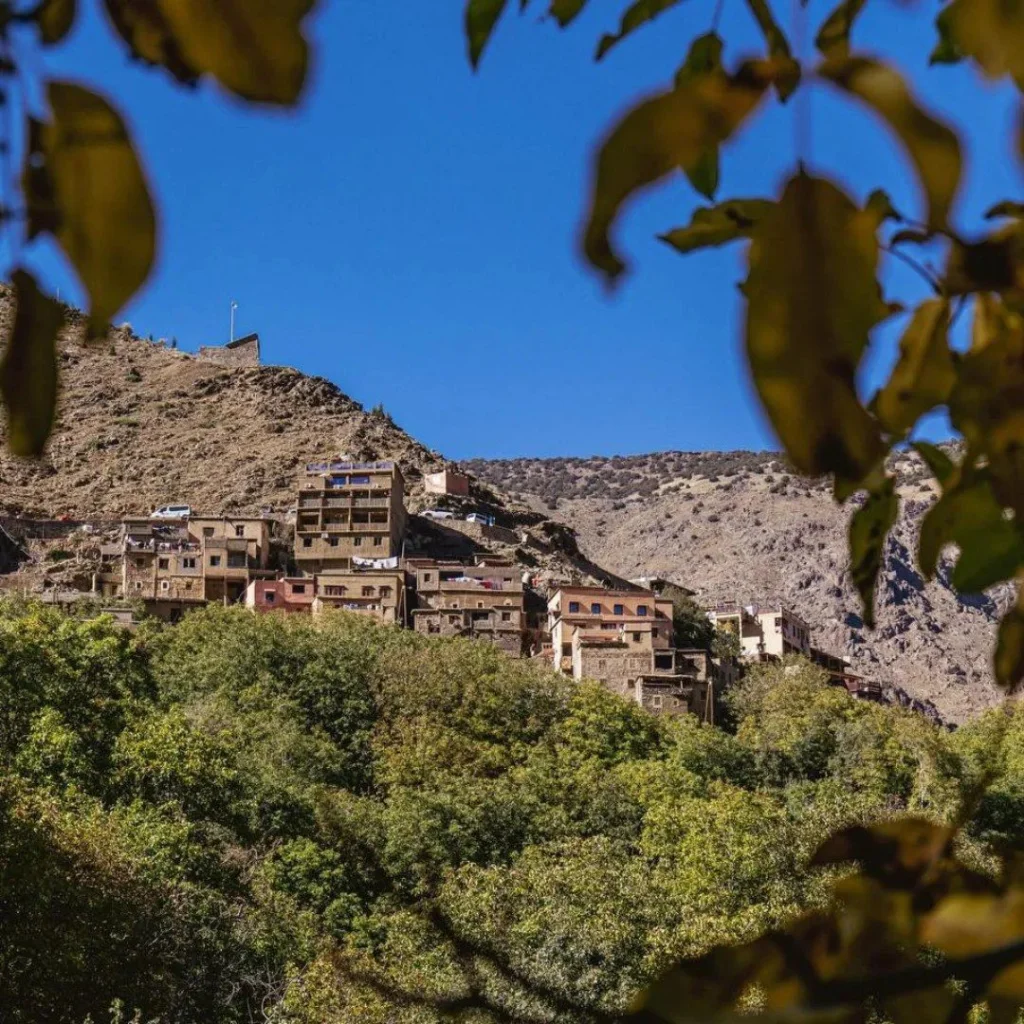
The Atlas is Morocco’s great mountain range. The High Atlas is home to Toubkal, which at 4,167 metres is the highest peak in North Africa. You’ll find terraced Berber villages built of mud brick, green valleys and some of the best hiking in the country.
Things to do in the Atlas
- Visit Imlil and the Berber villages around it, 1.5 h from Marrakech.
- Hike for a day or several, or climb Toubkal with a guide.
- Take a day trip to the Ourika Valley or the Ouzoud waterfalls.
- Cross the Tizi n’Tichka pass on the way to the desert.
- In the Middle Atlas: walk in the cedar forests near Azrou, home to Barbary macaques, and stop in Ifrane, the “Switzerland of Morocco”.
How long: anything from a day trip to a multi-day trek.
Best time: spring and autumn. In winter the peaks are covered in snow.
Best for: hiking, nature, families.
Local insight: the Fes–Merzouga route crosses the Middle Atlas along the way. Stopping in the Azrou cedar forest is one of the surprises of the journey.
8. Todra Gorge and Dades Valley
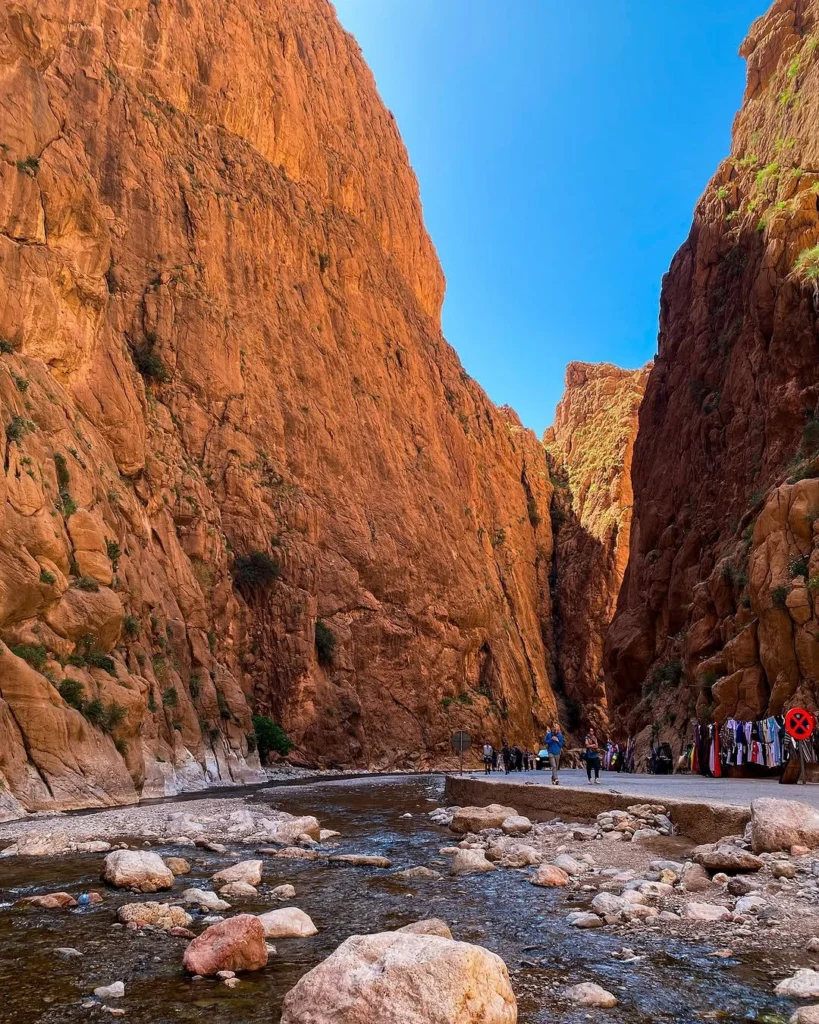
On the road between the Atlas and the desert are two landscapes that are usually visited together: the Todra Gorge and the Dades Valley.
The Todra Gorge, near Tinghir, is a canyon whose rock walls rise to about 300 metres. At its narrowest, the passage is only a few metres wide. The Dades Valley is known for its rock formations, its kasbahs and the winding Tissadrine road, one of the most photographed in the country.
Things to do at the Todra and Dades
- Walk along the bottom of the Todra canyon and through the Tinghir palm grove.
- Take photos from the viewpoint above the Dades hairpin bends.
- Drive the Road of a Thousand Kasbahs.
- Visit the Valley of Roses in Kelaat M’Gouna, which holds its rose festival in May.
How long: half a day for each. Most travellers spend a night in the Dades.
Best for: nature, photography, climbing.
How to combine them: they’re essential stops between Merzouga and Aït Ben Haddou.
9. Rabat, the Capital
Rabat is Morocco’s capital and one of its calmest, cleanest cities. In 2012 UNESCO listed its modern capital and historic city together as a World Heritage Site.
What to see in Rabat
- Kasbah of the Udayas: white and blue lanes above the mouth of the Bou Regreg River, facing the Atlantic.
- Hassan Tower: an unfinished 12th-century minaret next to the Mausoleum of Mohammed V.
- Chellah: Roman and Marinid ruins surrounded by gardens.
How long: 1 day.
Best for: history, and travellers who want a more relaxed Moroccan city.
How to combine it: it’s one hour by train from Casablanca and about 2.5–3 h from Fes. It’s a good first stop if you fly into Casablanca or Rabat.
10. Volubilis
Volubilis is the most important Roman archaeological site in Morocco and a UNESCO World Heritage Site since 1997. It sits among olive groves about 30 km from Meknes. It still has mosaics in their original places, the Arch of Caracalla, the basilica and the remains of large Roman houses.
How long: 2–3 hours.
Best for: history, archaeology.
How to combine it: usually visited on a day trip from Fes, together with Meknes and the holy town of Moulay Idriss.
Local insight: go first thing in the morning or late in the afternoon. There’s very little shade, and in summer midday is very hot.
Comparison table: places to visit in Morocco
| Destination | Highlights | Recommended time | Best for | Best season |
|---|---|---|---|---|
| Marrakech | Medina, Jemaa el-Fna, palaces | 2–3 days | First trip, couples | Oct–May |
| Chefchaouen | Blue medina, Rif | 1–2 nights | Photography, calm | Mar–Jun, Sep–Nov |
| Merzouga | Erg Chebbi dunes, desert camp | 1–2 nights | Couples, adventure | Oct–Apr |
| Fes | Medieval medina, tanneries | 2 days | History, crafts | Mar–May, Sep–Nov |
| Aït Ben Haddou | UNESCO mud-brick ksar | 2–3 hours | Film, photography | Year-round |
| Essaouira | Coast, ramparts, port | 1–2 days | Relaxing, families | Year-round |
| Atlas | Berber villages, Toubkal | 1 to several days | Hiking | Apr–Jun, Sep–Oct |
| Todra and Dades | Canyons and kasbahs | Half a day each | Nature | Mar–May, Sep–Nov |
| Rabat | Kasbah of the Udayas | 1 day | History, calm | Year-round |
| Volubilis | Roman ruins | 2–3 hours | Archaeology | Spring, autumn |
How to choose your destinations
- Imperial cities (Marrakech, Fes, Rabat, Meknes): for culture, architecture, souks and food.
- The desert (Merzouga): the experience travellers remember most. It needs at least 3 days from Marrakech or Fes.
- The Atlantic coast (Essaouira): perfect for relaxing at the end of the trip.
- Mountains and nature (Atlas, Todra, Dades): scenery, hiking and rural Berber life.
- Short on time? It’s better to see fewer places properly than to spend your trip in the car.
Sample Morocco itineraries
These routes are examples and can be adapted to your dates and pace. Driving times are approximate.
7-day route: Marrakech, the desert and Fes
- Days 1–2: Marrakech.
- Day 3: Marrakech → Tichka pass → Aït Ben Haddou → Dades Valley.
- Day 4: Todra Gorge → Merzouga. Camel ride and a night at the desert camp.
- Day 5: sunrise on the dunes → Middle Atlas (Ifrane and the cedar forest) → Fes. This is a long day, about 8 h.
- Days 6–7: Fes and a day trip to Volubilis.
10-day route: imperial cities, the north and the desert
- Day 1: Casablanca → Rabat.
- Days 2–3: Chefchaouen.
- Day 4: Volubilis and Meknes → Fes.
- Day 5: Fes.
- Day 6: Fes → Merzouga.
- Day 7: Todra → Dades.
- Day 8: Aït Ben Haddou → Marrakech.
- Days 9–10: Marrakech.
14-day route: the complete Morocco
This is the 10-day route with these additions:
- A second night in the desert.
- A night in Aït Ben Haddou or Ouarzazate.
- A night in a High Atlas village.
- 2 days in Essaouira to finish by the sea.
This route covers all 10 places in this guide without rushing.
Best time to visit Morocco
The best time to visit Morocco is spring (March–May) and autumn (September–November), when temperatures are pleasant across most of the country. The climate varies a lot from region to region:
- Desert: October to April. Summer days are extremely hot and winter nights are cold.
- Atlas: snow in winter. The Tichka pass can occasionally close for a day.
- Coast: mild all year round. A good summer destination.
- Inland cities: Marrakech and Fes often pass 38–40 °C in July and August.
Note that high season runs from late September to spring. Riads in the Marrakech medina and desert camps fill up quickly, especially at Christmas, so book ahead.
Practical tips
- Clothing: wear comfortable clothes that cover your shoulders and knees in medinas and villages. Bring a warm layer for nights in the desert and the Atlas.
- Money: the currency is the Moroccan dirham. Carry cash for souks, tips and small villages, as cards aren’t accepted everywhere.
- Distances: mountain roads are slow. Plan journeys in hours, not kilometres.
- Bookings: book ahead in high season, especially riads and desert camps.
- Insurance: get travel insurance and check your government’s official travel advice before you go.
- Opening hours: check up-to-date opening hours and prices for monuments and gardens before visiting.
Travel tip: one route that covers most of these places
If you want to see most of this list in just a few days, the best option is the Fes – Merzouga – Marrakech route. It’s our signature route at Travelinn Morocco and crosses the country from north to south through the Middle Atlas, the desert and the High Atlas.
Places from this guide on the route: Fes, the Atlas Mountains, the Merzouga desert (Erg Chebbi), the Todra Gorge, the Dades Valley, Aït Ben Haddou and Marrakech. That’s 7 of the 10 places, and you also pass through Ifrane, the Azrou cedar forest and the Valley of Roses.
- Day 1 – Fes → Merzouga: cross the Middle Atlas (Ifrane and the cedar forest) and the Ziz Valley. Ride a camel to your camp at sunset and spend the night under the stars.
- Day 2 – Merzouga → Todra → Dades: sunrise on the dunes, a walk through the Todra Gorge and a night in the Dades Valley.
- Day 3 – Dades → Aït Ben Haddou → Marrakech: drive the Road of a Thousand Kasbahs and the Valley of Roses, visit the ksar of Aït Ben Haddou and cross the High Atlas over the Tichka pass to Marrakech.
We run it as a private tour, with a driver and vehicle just for you. Price on request. It can be extended to add Chefchaouen, Volubilis, Rabat or Essaouira and complete all 10 places.
👉 Message us on WhatsApp at +34 663 35 87 44 and we’ll plan the route around your dates.
FAQ: what to see in Morocco
What are the most beautiful places in Morocco?
Marrakech, Fes, Chefchaouen, the Merzouga desert, Aït Ben Haddou, Essaouira, the Atlas Mountains, the Todra Gorge, Rabat and Volubilis. Together they cover imperial cities, desert, mountains and coast.
How many days do I need in Morocco?
- In 7 days you can see Marrakech, the desert and Fes.
- In 10 days you can add the north (Chefchaouen, Rabat and Volubilis).
- In 14 days you can see almost the whole country without rushing, including the coast at Essaouira.
Where is the best place to see the Sahara Desert in Morocco?
Merzouga, next to the Erg Chebbi dunes. It has the tallest, most accessible dunes in the country and plenty of camps for a night in the desert.
Can I visit the desert from Marrakech in one day?
It’s not a good idea, because Merzouga is about 9–10 hours away by road. A route of at least 3 days with a night in the desert works much better.
Is it better to travel independently or with a private tour?
The cities are easy to explore on your own. For the desert and Atlas route, a private tour saves a lot of time: distances are long, public transport is limited and a local driver knows the best stops.
Is Morocco good for couples and families?
Yes. Couples usually love the desert, Chefchaouen and the riads of Marrakech. Families enjoy the desert (camels and quads), Essaouira and the Atlas.